Beyond the Burn: 5 Unexpected Benefits of Social Fitness That Transform More Than Just Your Body
The Silent Epidemic Behind Closed Gym Doors
Seventy-six percent of Americans report feeling lonely during their fitness journeys, according to a 2023 American Psychological Association study. This statistic isn’t just surprising—it’s alarming. As we’ve collectively migrated toward app-guided solo workouts and home gym setups, something fundamental has been lost in translation: the human connection that once defined physical activity throughout history.
Sarah Chen discovered this disconnection firsthand after six months of regimented solo training. “I was getting physically stronger,” she recalls, “but something was missing. I dreaded my workouts. It felt like another box to check rather than something I looked forward to.” Her experience mirrors countless others who find themselves trapped in a paradox—following fitness influencers on social media while feeling increasingly isolated in their actual fitness practice.
This isolation runs counter to our evolutionary heritage. For thousands of years, humans moved together—hunting, gathering, dancing, and celebrating through collective physical exertion. The modern fitness industry, with its emphasis on personal metrics and individual achievement, has inadvertently engineered out this crucial social component. The consequences extend far beyond just workout adherence.
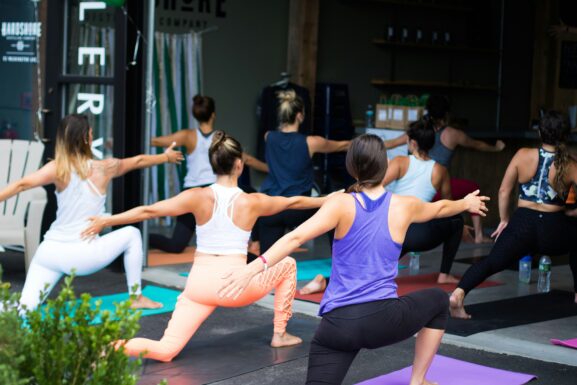
The solution isn’t complicated, but it runs counter to many current fitness trends. Social fitness—exercising in groups, with partners, or as part of a community—delivers transformative benefits that transcend physical changes. While most people understand that group workouts might help with motivation, the deeper, life-changing impacts remain largely undiscussed.

1. The Mental Health Revolution Nobody’s Talking About
When Kevin Martinez joined a neighborhood running group after his divorce, he expected physical benefits. What he didn’t anticipate was how profoundly it would impact his depression. “On days when I couldn’t even get out of bed for myself, I’d somehow find the strength to show up because others were expecting me,” he explains. “Three months in, my therapist noticed such dramatic improvements that we reduced my medication.”
Kevin’s experience isn’t an anomaly. A groundbreaking study published in the Journal of American College Health found that participants in group exercise programs reported a 26% greater reduction in stress levels compared to solo exercisers, even when controlling for workout intensity and duration. The researchers identified several mechanisms behind this effect: the release of endorphins combined with social engagement creates a neurochemical cascade that solo workouts simply cannot replicate.
Dr. Leila Hosseini, a neuropsychologist specializing in exercise psychology, explains: “The synchronization of movement with others creates a unique brain state that magnifies the mental health benefits of physical activity. When we move together, additional neural pathways activate—pathways associated with social connection, trust, and emotional regulation.”
This synchronization effect explains why group fitness participants report significantly lower rates of anxiety and depression compared to individual exercisers, even when total exercise minutes are identical. The social component doesn’t just add to the mental health benefits—it multiplies them.
What’s particularly remarkable is how quickly these benefits manifest. Research from the University of New England shows measurable improvements in anxiety levels after just two group workout sessions, whereas solo exercisers typically required eight sessions to achieve comparable results.
2. The Community Connection That Rebuilds Social Fabric
In an era where 61% of young adults report feeling “seriously lonely” according to Harvard research, fitness communities are quietly becoming modern replacements for the social structures that once connected neighborhoods. These connections run deeper than casual gym acquaintances.
Emma Wilson, a 34-year-old marketing executive, moved to Cincinnati knowing no one. “I joined a Saturday morning trail running group mostly to explore the area,” she says. “Two years later, these people helped me move apartments, celebrated my promotion, and became my emergency contacts. My running community became my chosen family.”
Social scientists are increasingly recognizing these fitness communities as “third places”—locations separate from home and work where people develop crucial social bonds. Dr. James Montgomery, a sociologist studying modern community formation, notes: “As traditional community institutions like religious organizations and civic clubs have declined in membership, fitness communities have emerged as powerful replacements, especially for adults under 40.”
The depth of these connections often surprises participants. A longitudinal study tracking CrossFit community members found that 67% had made what they classified as “close friendships” within six months of consistent participation, with 42% reporting that these relationships had expanded beyond the fitness environment.
More remarkably, these fitness communities often bridge demographic divides that remain entrenched in other social contexts. Data from community running organizations shows more socioeconomic and racial diversity than most voluntary associations, with 78% of participants reporting meaningful relationships with people outside their typical social circles.
This community-building effect extends beyond immediate participants. The “Parkrun” phenomenon, which organizes free community 5K events worldwide, has documented significant increases in overall neighborhood cohesion in areas where these events occur regularly. Residents report greater trust of neighbors and increased civic engagement, even among those who never participate in the runs themselves.
3. The Accountability Factor That Transforms Habits
The statistics are sobering: 73% of people who exercise alone abandon their routines within six months. In contrast, those with workout partners or group commitments maintain consistency at rates exceeding 78% over the same period. This dramatic difference speaks to the power of social accountability—a force that transforms fleeting motivation into lasting habits.
Michael Peterson, a 41-year-old software developer, had started and stopped fitness programs more times than he could count. “The difference this time was simple—I committed to meet my workout group three times weekly at 6 AM. Missing meant sending five people a text explaining why. That single change has kept me consistent for over two years now.”
The science behind this consistency reveals something profound about human psychology. Dr. Vanessa Richardson, who studies habit formation at Columbia University, explains: “We’ve found that social commitment creates a fundamentally different neural pathway than solo commitments. When we promise others we’ll show up, the decision moves from the prefrontal cortex, where willpower resides, to more automated brain regions associated with social obligation.”
This neurological shift explains why social fitness participants report significantly less internal resistance on days when motivation is low. The accountability transcends mere peer pressure. Research from the American Journal of Health Behavior demonstrates that group exercise participants develop stronger “exercise identities”—they begin to see themselves as “the kind of person who exercises regularly,” which creates powerful intrinsic motivation that persists even when external accountability is temporarily absent.
The effects extend to performance as well. Studies consistently show that people work at 15-20% higher intensity levels in group settings compared to solo workouts, even without explicit competition. The “Köhler Effect,” a psychological phenomenon where less capable group members exert more effort to keep up with others, creates natural progressive overload that solo exercisers must consciously engineer.
4. The Unexpected Skill Development Beyond Physical Fitness
When Raj Patel joined an adult soccer league, his primary goal was cardiovascular fitness. He didn’t anticipate developing conflict resolution skills, emotional intelligence, and leadership abilities that would later earn him a significant promotion at work. “The soft skills I developed organizing practices and navigating team dynamics directly translated to managing my department,” he reflects.
This skill development represents one of social fitness’s most overlooked benefits. Research from the Corporate Executive Board found that employees who participated in team sports or group fitness programs scored 19% higher on collaboration assessments and 23% higher on communication evaluations compared to employees who exercised alone or not at all.
Dr. Elizabeth Chen, an organizational psychologist who studies workplace performance, has documented this phenomenon extensively: “The physical challenges in group fitness create natural opportunities to practice vulnerability, resilience, and supportive communication in low-stakes environments. These experiences build emotional muscles that directly transfer to professional settings.”
Beyond interpersonal skills, social fitness environments accelerate learning of physical techniques through observation and peer coaching. A study comparing solo learners to those in group environments found that the latter mastered complex movement patterns 34% faster, even without formal instruction.
The learning extends to health literacy as well. Research published in the Journal of Health Communication demonstrates that social fitness participants develop significantly better understanding of nutrition, recovery principles, and overall wellness through informal knowledge sharing. This “community wisdom” often proves more actionable than the information provided in formal health education.
Perhaps most importantly, participants develop what psychologists call “growth mindset”—the belief that abilities can be developed through dedication and hard work. Seeing peers progress and overcome obstacles creates powerful vicarious learning experiences that transform how participants approach challenges in all areas of life.
5. The Motivational Chemistry That Makes Exercise Enjoyable
The data is clear but counterintuitive: 91% of group exercise participants report looking forward to their workouts, compared to just 36% of solo exercisers. How can adding social complexity to an already challenging activity make it more enjoyable rather than less?
Lisa Thompson, a 53-year-old accountant who discovered group fitness after decades of forcing herself through solitary gym sessions, describes the shift: “For thirty years, exercise was something I endured because I should. Now it’s something I anticipate because I genuinely enjoy it. The difference is the people and the shared energy.”
This transformation from obligation to enjoyment represents the most sustainable path to lifetime fitness. Neurochemistry explains part of this shift. Dr. Martin Rodriguez, a researcher studying exercise adherence, notes: “Group workouts create a neurochemical cocktail we don’t see in solo exercise—endorphins combined with oxytocin and serotonin release creates a sense of euphoria and connection that the brain begins to crave.”
Beyond chemistry, psychological factors amplify enjoyment. Flow states—those periods of complete immersion and focus—occur more frequently in group settings according to research from the Positive Psychology Center. The combination of social engagement and physical challenge creates ideal conditions for this optimal psychological state.
The motivational environment also reframes how we experience exercise discomfort. Studies using pain threshold measurements reveal that participants in group settings perceive physical discomfort as significantly less intense compared to solo exercisers performing identical workouts. This perceptual shift transforms challenging workouts from deterrents to achievements.
The enjoyment factor creates a virtuous cycle: People who find exercise intrinsically rewarding maintain consistency without requiring willpower or discipline. They’ve transcended the fundamental challenge that derails most fitness journeys—the reliance on fluctuating motivation rather than genuine enjoyment.
Finding Your Social Fitness Community
If these benefits resonate with you, the next question becomes practical: how do you find the right social fitness environment? The options extend far beyond traditional group fitness classes.
Maria Chen spent months trying different fitness communities before finding her fit. “The breakthrough came when I realized I needed to prioritize the social connection over the specific activity,” she explains. “I discovered I’d rather do a workout I was less excited about with people I connected with than my ‘ideal’ workout with a group that didn’t feel right.”
This insight aligns with research on exercise adherence, which consistently shows that social compatibility predicts long-term participation more accurately than interest in the specific activity. The ideal environment combines sufficient physical challenge with strong social connection—a combination that varies widely between individuals.
The good news is that the social fitness landscape has never been more diverse. Beyond traditional gym classes, options include outdoor adventure groups, sports leagues for all skill levels, dancing communities, hiking clubs, neighborhood walking groups, and specialized communities focused on specific populations or interests.
The challenge isn’t a lack of options but rather finding the right match—a process that often requires experimentation. This exploration phase is where many people abandon the search, missing out on the transformative benefits that await.
How Socio.fit Bridges the Connection Gap
This connection challenge is precisely what Socio.fit was designed to solve. By curating local social fitness opportunities and matching individuals based on compatibility factors beyond just the activity itself, the platform removes the friction that prevents many people from discovering their ideal fitness community.
Unlike generic fitness directories or social media groups, Socio.fit’s matching algorithm considers factors proven to predict social compatibility and exercise adherence: personality alignment, communication styles, fitness goals, schedule compatibility, and values orientation. This multifaceted approach dramatically increases the likelihood of finding a sustainable fitness community.
The platform’s founder, Maya Williams, explains the vision: “We created Socio.fit after recognizing that the biggest barrier to experiencing the benefits of social fitness wasn’t a lack of options but rather the difficulty in finding the right fit. When that connection happens, the transformation extends far beyond physical fitness.”
Early adopters report significant improvements in finding compatible fitness communities. Jennifer Lawrence, a 37-year-old who had cycled through five different exercise groups without finding the right fit, describes her experience: “Socio.fit connected me with a morning strength training group where I instantly felt at home. Six months later, I’ve not only maintained perfect attendance but also developed friendships that have changed my life beyond recognition.”
Beyond Physical Transformation: The Whole-Life Impact
The most remarkable aspect of social fitness isn’t any single benefit but rather how these advantages compound and intersect, creating transformation that extends far beyond physical appearance or performance metrics.
The research is conclusive: people who exercise in supportive social environments report significantly higher overall life satisfaction, better work performance, improved relationship quality, and greater resilience during life challenges. The physical improvements—while valuable—represent just the visible surface of far deeper positive change.
Dr. Katherine Jenkins, who studies quality-of-life metrics, summarizes it simply: “When we examine the factors that most reliably improve subjective well-being, social connection and physical activity consistently rank among the top five. Social fitness delivers both simultaneously, creating a multiplier effect that’s difficult to achieve through any other single lifestyle change.”
This understanding transforms how we might approach fitness goals. Rather than pursuing physical transformation alone, the evidence suggests that seeking a sustainable, enjoyable social fitness practice delivers more profound life improvements—with physical benefits occurring naturally alongside deeper psychological and social transformation.
If you’ve struggled with consistency, enjoyment, or finding meaning in your fitness routine, consider that the missing element might not be the right workout plan or more discipline—it might be the right people. The community that will transform your relationship with fitness is out there, waiting to welcome you.
Take the first step toward discovering your social fitness community by exploring local options through Socio.fit. Your body will change, but the most meaningful transformations might surprise you.